Should HA Hydrate go on damp skin?
The published directions suggest slightly damp skin. Press in 3 to 4 drops, let the serum settle, then follow with moisturizer.
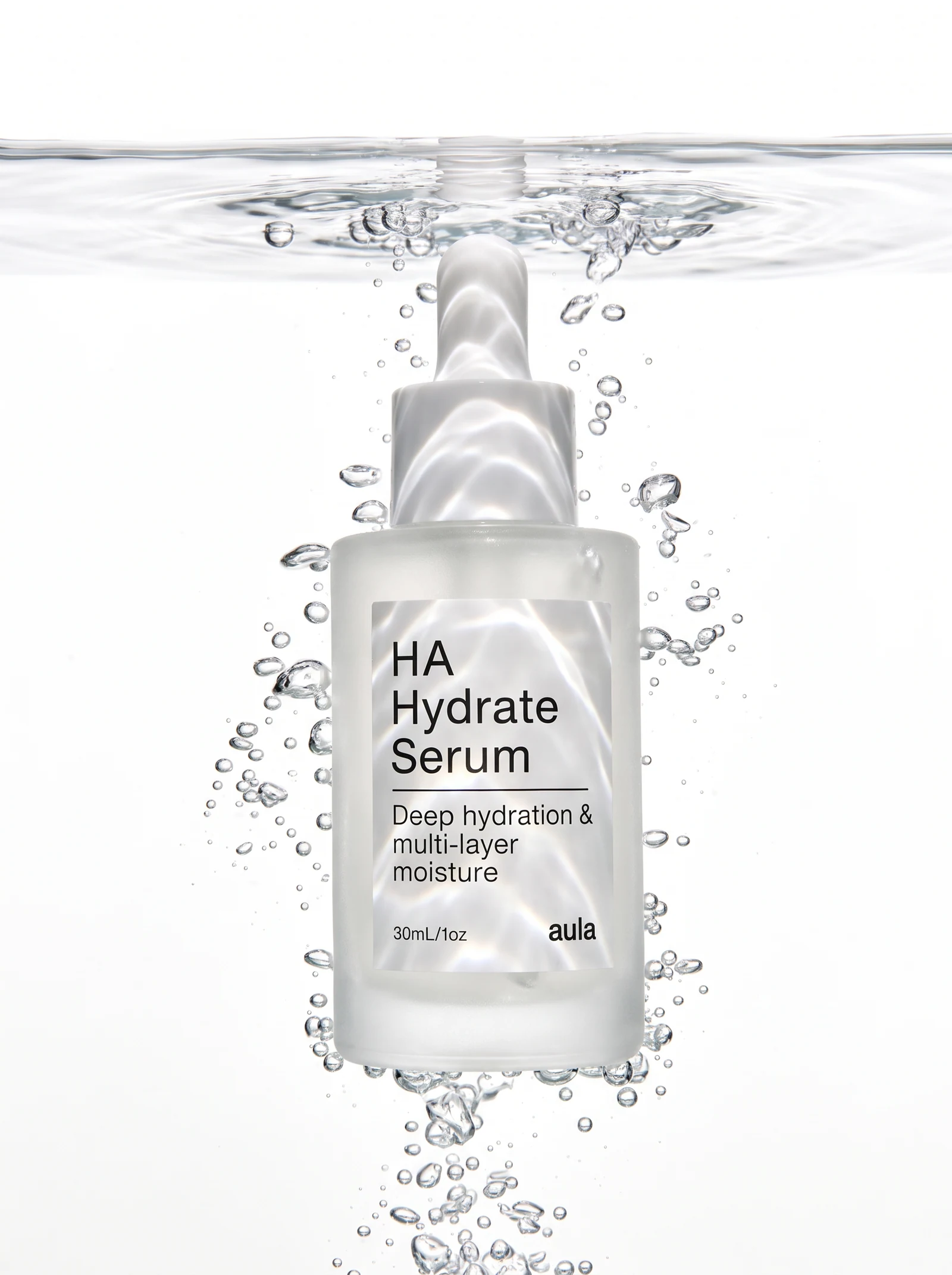
HA HYDRATE · 30ML / 1OZ · $38
11 forms of HA. One serum.
Hydration that reaches every layer, and stays there.
Face serum · Available to order
Most hydrating serums use one form of hyaluronic acid. This one uses eleven, four chemistry types across seven molecular weights, from 3,000 Daltons to 2.3 million. Each form does a specific job: the largest sit on the surface and form a breathable film that locks moisture in, the smallest penetrate to the dermis where they hydrate from below and signal the skin to make more of its own HA. The result is hydration that works at every depth and lasts past the first hour.
Four chemistry types, Sodium Hyaluronate Crosspolymer, Sodium Hyaluronate, Sodium Acetylated Hyaluronate, and Hydrolyzed Sodium Hyaluronate, each delivered across seven molecular weights spanning 3,000 to 2,300,000 Daltons. The crosspolymer forms a breathable surface film. The acetylated form adheres to the stratum corneum and resists rinse-off. Standard HA holds moisture at and just below the surface. The hydrolyzed (low-MW) fragments penetrate to the dermis. Eleven functional forms in one bottle.
Corneometer measurement on a multi-weight HA system, vs untreated skin, single application. The same study shows +127.5% hydration vs single-MW HA at the same timepoint, meaning the multi-weight approach roughly doubles what one HA alone delivers. Hydration is what the data measures; what you'll feel is plumpness in minutes that holds through the day.
Transepidermal water loss, the rate at which skin leaks moisture, is the metric that tells you whether hydration is actually staying in. The seven-molecular-weight HA system in this formula reduces TEWL by 31.7% at 24 hours vs placebo, and is 10× better than placebo at locking moisture in by hour 24. After 28 days of twice-daily use, skin moisture capacity goes up 58%.
The lowest-molecular-weight fragments (3,000 to 50,000 Da) penetrate past the stratum corneum and signal fibroblasts in the dermis to upregulate native hyaluronic acid synthesis. Topical HA isn't just a humectant here, it's a signal. Use builds on itself: the longer you stay on it, the more your skin makes on its own. Formulated and made in our own cGMP lab.
Forms a breathable film that locks moisture in. The surface plumping agent.
The structural backbone, holds water in the upper skin layers so hydration stays through the day.
Adheres to skin and keeps hydrating even after rinsing, longer-lasting than standard HA.
Smallest fragments, penetrates deep and signals your skin to make more of its own HA.
Aqua (Water), Polyacrylate Crosspolymer-6, Glycerin, Pentylene Glycol, Sodium Hyaluronate Crosspolymer, Sodium Hyaluronate, Sodium Acetylated Hyaluronate, Hydrolyzed Sodium Hyaluronate, Phenoxyethanol, Ethylhexylglycerin.
Free of: fragrance, essential oils, dyes, silicones, sulfates, parabens, alcohol denat. Vegan. Cruelty-free.
Pair it with
A closer look
The published directions suggest slightly damp skin. Press in 3 to 4 drops, let the serum settle, then follow with moisturizer.
The published Vitamin C Bright routine places that serum before HA Hydrate in the morning. Introduce the products separately first to check tolerance. Explore Vitamin C Bright.
Not necessarily. This serum supplies a humectant step; a separate face moisturizer can help retain moisture if your skin needs it. Explore Barrier Repair Cream.